Intermediate interview questions in UX Research

How does UX research integrate into a two-week agile sprint?
This tests if you see research as ongoing discovery, not a predev phase. A good answer covers backlog work across sprints, outcome-based prioritization, and engineer touchpoints in refinement. Red flag: saying research happens only before coding starts.

Generative versus evaluative research: when to use each
Generative precedes design to find needs; evaluative follows a build to test it.
Anonymization vs pseudonymization and key handling
Anonymization is irreversible and exits GDPR scope; pseudonymization is reversible via a separated key; secure that key in a KMS with strict access.

How do you fulfill a GDPR erasure request across data stores?
This tests cross-system deletion under GDPR's 30-day SLA. A strong answer maps PII lineage across S3, databases, and analytics; uses soft deletes for backups; and handles dashboards via reprocessing.

Design a centralized consent platform: core components and database schema
Separate CMF from CMP; build an append-only ledger with versioned wording, per-activity granularity, and real-time revocation.
How do you validate UX within hard technical constraints?
Tests evaluative research design for constrained, buildable prototypes rather than ideal mocks. Strong answers scope to feasible layers, use Wizard of Oz or stubs, and benchmark against current state. Red flag: testing fantasy UI that ignores API limits.

What technical instrumentation supplements a two-week diary study?
Log anonymized feature frequency, session duration, and device switches; link via participant ID.

Propose two research methods to investigate checkout abandonment
Tests pairing behavioral and attitudinal research. Great answers match funnel analytics to find drop-offs with usability tests to uncover why users cannot complete fields or leave in anger.

What criteria and questions ensure right users for a specialized dev tool?
Designing a recruiting pipeline that qualifies niche experts and secures attendance. A strong answer covers role criteria, layered tech screens, and no-show backups. Red flag: relying on job titles without verifying real tool usage.
What two techniques mitigate professional-tester bias in screener design?
Swap guessable questions for behavioral ones about real tasks, and add exclusion criteria to block web-savvy professional testers.
Build a compliant participant recruitment database
Capture granular, timestamped consent with lawful basis; minimize, encrypt, and retention-limit storage; and build self-service deletion that cascades.
Describe a workflow to automate a 50-person diary study
Tests operational UX research automation and API integration. A strong answer maps a pipeline of calendar APIs, email triggers, and reminder bots with no-show fallbacks. Red flag: manual spreadsheets or survey tools lacking scheduling logic.

Propose a strategy for finding and vetting low-incidence participants
This tests sourcing creativity and screening rigor for rare populations. A strong answer proposes niche outreach, snowball referrals, behavioral screeners, and anti-fraud checks. A red flag is simply boosting spend on generic panels or relying on coworkers.
Translate qualitative insights into user stories and requirements
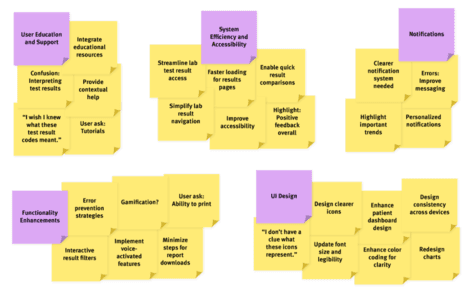
Clusters themes by frequency/severity, reframes pain points as user stories with clear AC, maps to technical spikes, prioritizes by impact.

How do you mitigate confirmation bias when a user validates your solution?
In the moment, probe for exceptions; in synthesis, triangulate and invite reviewers.

How would you use a journey map to find technical root causes?
Map journey stages to logs and traces, find bottlenecks, propose API or data model changes.
Diagnose and validate a failing usability task
Pinpoint the failure step from session and telemetry data, form a root-cause hypothesis, ship a targeted fix, and re-test to validate.
How could you adapt usability testing principles to evaluate two API designs?
Tests holistic API UX beyond static syntax. Strong answers propose observing developers in realistic IDE and doc contexts, noting errors and confusion across both designs.

What usability metrics would you instrument, and how do regressions drive priorities?
Tests operationalizing UX into engineering signals. Strong answers list success rate, time on task, and error rate; triage regressions by criticality; and pair quant drops with qual diagnosis. Red flag: calling every regression P0 or using vanity metrics.

How would you model user events to analyze cancellation paths?
Timestamped events with user and session IDs, separate entity snapshots, and time-range partitioning.
We are hiring for this. Every open role lists the topics its interview covers, so you can prepare for the real thing rather than guessing.
See open roles