Advanced interview questions in Product Management, page 10
How do you optimize a data warehouse for billions of rows?
Tests physical design in columnar warehouses at scale. Strong answers cover partition and cluster pruning, materialized views or rollups to reduce joins, caching and search indexes for hot paths, and reserved slots or autoscaling.
How should an EM facilitate reviews in a self-organizing team?
Tests separating feedback from pay, replacing individual ratings with systemic coaching. Cover: framing reviews as career development, biweekly 1:1s for meta-coaching, team raise pools, and obstacle removal. Red flag: stack ranking or hero worship.
Optimizing a Slow, Expensive Data Warehouse for BI Dashboards
Tests your grasp of data warehouse architecture beyond basic SQL. A great answer covers partitioning/clustering, materialized views for pre-aggregation, and cost controls. A red flag is suggesting only query rewrites or just 'adding more compute'.
How do you manage performance in a self-organizing team?
This tests your ability to shift from individual performance management to fostering team-based career development. A great answer reframes the goal, uses frequent 1-on-1s for coaching, and decouples raises from feedback.
How would you optimize a slow, expensive data warehouse?
Tests your diagnostic approach to performance issues. A good answer first analyzes query patterns, then applies partitioning by date, clustering by high-cardinality keys, and materialized views for aggregations.
How to manage performance reviews in self-organizing agile teams?
This tests your servant leadership mindset. Reframe "performance management" as "career development," use frequent 1-on-1s for coaching and obstacle removal, and separate compensation from feedback. Red flag: focusing on individual metrics or stack ranking.
Describe a strategy for reconciling different forecasts into one robust prediction
Tests synthesis of heterogeneous models into a consensus forecast. Strong answers diagnose divergence drivers first, then weight by track record or uncertainty, and output a distribution. Red flag: blind averaging without understanding why models disagree.

Design a near real-time pipeline to monitor orders per minute
Tests stream architecture and batch trade-offs. Outline: Kafka or Kinesis ingestion, Flink with tumbling windows, Druid or Pinot storage, Grafana alerts. Contrast batch on latency, exactly-once semantics, and cost. Red flag: calling cron SQL real-time.
Design a Near Real-Time Analytics Pipeline
Tests your ability to design a low-latency data system and articulate trade-offs. A good answer covers ingestion (Kafka), processing (Flink), storage (Druid), and visualization (Grafana), contrasting the architecture's low latency with a batch setup.
Design a near real-time analytics pipeline for a critical metric
This tests your grasp of stream processing trade-offs (latency, cost, correctness). Outline a 4-stage pipeline (ingest, process, store, visualize) with specific tech choices, contrasting its low-latency, high-cost nature with batch.

How would you detect, mitigate, and penalize a noisy neighbor?
This tests multi-tenant fairness and governance. A strong answer covers tenant telemetry, graduated throttling, autoscaling with cost caps, and penalty tiers that curb abuse yet allow spikes. Red flag: hard limits before detection or graduated response.

Propose a long-term strategy to decompose a monolith while maintaining API stability
This tests strategic prioritization and incremental migration without ecosystem breakage. Start with simple decoupled capability, go macro first then micro, split vertically by domain owning data, and use atomic steps with facades to preserve APIs.
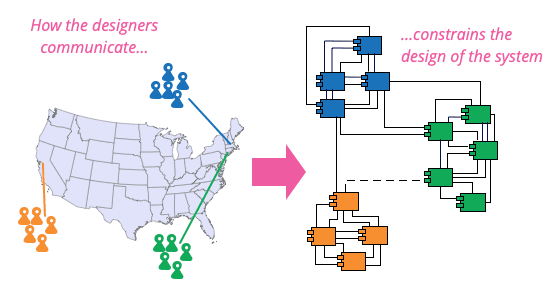
How would you apply Conway's Law to design team structures for microservices?
Map bounded contexts to cross-functional teams; use APIs as contracts; split by decoupling boundary.
How would you apply Conway's Law to design team structures?
This tests applying organizational theory to technical strategy. A great answer defines the law, explains the 'Inverse Conway Maneuver' by structuring teams around business capabilities, and avoids imposing an architecture without changing team structure…
How to apply Conway's Law to design team structures?
Tests if you can use Conway's Law proactively (the 'Inverse Conway Maneuver'). Outline: define the target architecture, then align small, autonomous teams to its components. A red flag is seeing the law only as a constraint, not a tool for intentional design.
Trade-offs: product teams vs project teams and funding model impacts
This tests funding impact on architecture. Contrast temporary project teams funded by scope versus product teams funded by problems; tie rolling budgets to ownership and refactoring. Red flag: claiming agile ceremonies fix org design while ignoring funding.
Design a real-time mobile analytics pipeline
Tests decoupling high-volume ingestion from low-latency querying. Strong designs use an event broker, a stream processor for windowed aggregates, and an OLAP database for sub-second dashboards.
Design a Real-Time Analytics Pipeline for Mobile Events
This tests your grasp of low-latency streaming architectures. A good answer outlines ingestion (SDK to Kafka/Kinesis), real-time processing (Flink/Spark), and sinking to a fast OLAP database (Druid/ClickHouse). A red flag is proposing a batch-based ETL design.
Trade-offs: Product-Based vs. Project-Based Teams
This tests your grasp of how funding models impact team ownership and code quality. Contrast project (temporary, build-only) vs. product (durable, continuous) teams, linking the latter to better knowledge retention and architecture.
Design a Real-Time Analytics Pipeline for Mobile Events
Tests your grasp of low-latency, high-throughput design. A strong answer outlines ingestion (Kafka), stream processing (Flink), and a real-time OLAP database (Druid/ClickHouse). A red flag is proposing a slow, batch-only architecture.
We are hiring for this. Every open role lists the topics its interview covers, so you can prepare for the real thing rather than guessing.
See open roles