Interview questions in Product Management, page 34

Track an 'Export to CSV' button's usage
This tests modeling a feature's full lifecycle (intent, success, failure) in analytics. Propose one custom event like export_interaction with a status parameter ('success', 'failure') fired on completion, not just on click.

SAFe vs. LeSS: Planning, Dependencies, and Autonomy
Tests your grasp of the trade-offs between coordination and autonomy in scaling frameworks. A good answer contrasts SAFe's top-down PI Planning with LeSS's bottom-up, team-focused approach.
Track an 'Export to CSV' button's usage and outcomes
This tests your ability to design a robust event schema, not just track a click. A great answer uses one custom event name with a 'status' parameter ('initiated', 'success', 'failure'). A red flag is suggesting multiple event names for one action.
SAFe vs. LeSS: Planning, Dependencies, and Autonomy
This tests your grasp of how org structure affects engineering work. Contrast SAFe's top-down, prescriptive nature (central PI planning) with LeSS's bottom-up, team-centric model (direct dependency management). A red flag is reciting buzzwords without context.

How would you detect, mitigate, and penalize a noisy neighbor?
This tests multi-tenant fairness and governance. A strong answer covers tenant telemetry, graduated throttling, autoscaling with cost caps, and penalty tiers that curb abuse yet allow spikes. Red flag: hard limits before detection or graduated response.

How would you implement a simple feature flag system?
Tests runtime config separation and distributed hygiene. Outline: control service, datastore, API, SDK, and update mechanism; local evaluation with cached state; short-lived flags. Red flag: static config files requiring redeployment are not feature flags.

Explain cohort retention and write a pseudo-query for May signups
Tests cohort retention vs aggregate DAU and SQL self-joins for Week 1, 2, and 4 retention from May signups. Strong answers define cohorts by signup date, use datediff, and left-join activity. Red flag: using calendar week instead of relative signup date.
Why is velocity as a primary KPI destructive, and what's better?
This tests if you see velocity as a planning gauge, not a performance metric. A strong answer notes points are subjective, cites Goldratt on gaming, and proposes team-driven improvement instead. A red flag is claiming velocity works if averaged over time.
Explain cohort analysis and write a retention query
Tests your grasp of user behavior metrics. First, define a cohort (e.g., May signups). Then, explain why it's better than aggregate retention. Finally, outline a query grouping users by signup week and checking for activity. A red flag is a flawed query.
Why is team velocity a poor KPI for agile success?
Tests your grasp of agile principles and Goodhart's Law. Explain velocity is for forecasting, not performance. Detail dysfunctions like point inflation and ignoring quality. Propose outcome-focused alternatives like cycle time.
Explain cohort analysis for user retention and write a pseudo-query
Tests your ability to use precise metrics. A good answer defines a cohort, explains why it isolates variables better than aggregate data, outlines the calculation, and provides a clear pseudo-query.
Why is tracking team velocity as a KPI dysfunctional?
Tests if you know velocity is for planning, not performance. Explain it's easily gamed and measures output, not outcome. Propose metrics focused on value delivery and process improvement like cycle time.
Why consistent user IDs matter in experiments
The user id seeds deterministic bucketing and ties events to one person across devices; achieve it via authenticated ids and anonymous-to-known stitching.

Propose a long-term strategy to decompose a monolith while maintaining API stability
This tests strategic prioritization and incremental migration without ecosystem breakage. Start with simple decoupled capability, go macro first then micro, split vertically by domain owning data, and use atomic steps with facades to preserve APIs.

Design a data model for feature adoption tracking
Tests dimensional modeling for high-volume events so PMs can query Feature A not B without complex SQL. A strong answer uses an event fact table plus a materialized user-feature summary. Red flag: a wide user table with boolean columns per feature.
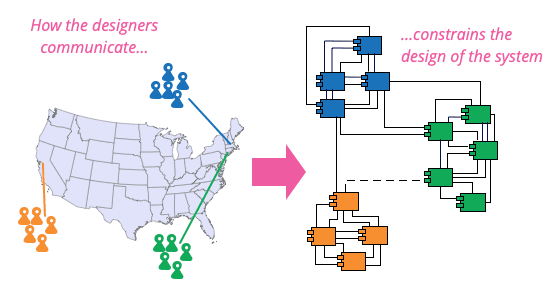
How would you apply Conway's Law to design team structures for microservices?
Map bounded contexts to cross-functional teams; use APIs as contracts; split by decoupling boundary.
Design a data model for tracking feature adoption
This tests your grasp of data warehouse star schemas for analytics. Outline a fact table for events and dimension tables for users and features, explaining how this structure enables fast, ad-hoc cohort analysis for a product manager.
How would you apply Conway's Law to design team structures?
This tests applying organizational theory to technical strategy. A great answer defines the law, explains the 'Inverse Conway Maneuver' by structuring teams around business capabilities, and avoids imposing an architecture without changing team structure…
Design a data warehouse model for tracking feature adoption
This tests your grasp of data warehousing star schemas for efficient behavioral analysis. A strong answer proposes a central events fact table linked to users, features, and time dimension tables.
How to apply Conway's Law to design team structures?
Tests if you can use Conway's Law proactively (the 'Inverse Conway Maneuver'). Outline: define the target architecture, then align small, autonomous teams to its components. A red flag is seeing the law only as a constraint, not a tool for intentional design.
We are hiring for this. Every open role lists the topics its interview covers, so you can prepare for the real thing rather than guessing.
See open roles